I sometimes think that I believe in two contradictory messages.
The first message I believe in is that gun ownership, just like the ownership of anything else is a matter of individual discretion, responsibility and personal liberty. What right does the state have to tell a person that he or she cannot own a gun? What gives them the right to tell you, as law abiding citizen that you cannot go out and get your own food, or shoot clay disks or other targets?
On the other hand, news of a child given a gun by his parents for his birthday and then went off and killed his kid sister. Of course it was an horrific accident and one that I will not use to make a message advocating gun control, but let me just say that the individual responsible is the parent. However, as there are people out there like those parents, we do need laws.
Where is the balance between these two messages? As the NRA top dog, Chris Cox stated, you can't blame lawful gun owners for these incidents. You have to blame the criminal or the person who though it was okay to give a gun to a child. This is a compelling argument. You wouldn't give your five year old a car to drive, would you? If you would, you probably should have your head examined.
As unfortunate as it may be, I think it is true that people cannot be given full right to buy anything they want without any kind of regulation because people do moronic things and sometimes those moronic actions spill over and have a broad public cost. The idea of any innocent person being harmed by another individual who has misused his rights is, to my mind, a compelling argument for gun control.
However, the vast majority of gun owners have never shot anyone. In fact, statistically, your neighbors swimming pool poses a greater danger to the public than his rifle. So, does that mean that we should ban his pool along with his gun? Perhaps not. There is a sensible middle ground here. As unfortunate as it is, we must make homeowners have safe premises and we must also encourage safe pool ownership.
We have natural rights and liberties, but we also have the responsibility that goes along with them.
I am well aware of the argument that some make that the United States government wishes to control your guns so that they may control you. I don't buy it. Folks, they have tanks and drones...your gun is not going to stop them. Rather, I think it is far less sinister. It is the madness of politics that drives these gun control efforts. The President and Congress want to be seen as acting. If they are found by the public to have not prevented a disaster, they will suffer in the next election. That is one of the unfortunate kinks in the electoral system. A focus on short-term priorities and a race toward some kind of action often trumps deep inquiry and long term solutions.
We balance budgets by cutting the very programs that are needed for long term economic success. We reduce medical school placements to save costs in one budget only to have to spend greatly later on to fix medical shortages. Leaders often have trouble keeping up. Top civil servants are often racing to provide answers to the politicians which just do not exist.
I think it is these factors which are more responsible for government action than plots to take away the rights of the public. The state is not a unitary actor with a single goal.
What I fear most is that the public will begin to panic against gun control, and that the government will react to that. The fear of the slippery slope has been reified. People really believe that that metaphor is true. Take away my semi-automatic, and the next step is that you'll take away my shotgun also.
So, on the one hand you have the desire to protect the public from a small number of criminals, and on the other hand you have a public that is overwhelmingly peaceful and shouldn't have the government interfering in ownership. I believe in both of these messages at the same time. I'm not so sure if they are contradictory. If they are, perhaps we just need to allow for these two contradictory impulses to exist at the same time and trust the legal system to find the balance.
Saturday, May 4, 2013


Friday, May 3, 2013
Thai PM: New "Seeing Eye" Police for Distracted Teens.
 |
| Thai Tourist Police on Segways |
 The government of Yingluck Shinawatra announced today that a new division under the Thai Tourist Police will begin guiding distracted teenagers through public streets by the end of this year.
"We love our young people and we want to be sure that they don't get hurt while they walk aimlessly around public places playing on their mobile devices". The move came after the Prime Minister was nearly hit by a train while waiting at Siam Station while on a recent tour of the BTS Skytrain.
"Our new, Seeing Eye Division will each be given a Segway so that they don't have to walk too much and we are also contracting a Chinese company to provide one tablet for each Seeing Eye Division officer so that they actually know where you want to go. Thank you three times."
 |
| PM Yingluck and her personal Seeing Eye Person |
In a separate press conference, Leader of the Opposition Democrats and former Prime Minister Abhisit Vejjajiva and Bangkok Governor Sukumband Paribatra (pictured left) stated that if the Prime Minister "bothered to consult with the people than she would know that her program won't work". Instead, the Democrats plan to create the Department of Public Seeing under Municipal Public Works.

"Our plan will have city employees guide distracted teenagers around in teams of two. One to carry the iPad, and the other to help the worker who is distracted by the iPad" stated the Governor.
Some reports have the number of teenagers distracted by mobile devices now outnumbering the seeing-eye teenagers 10-1.
Thursday, May 2, 2013
Ponderings on 7-Eleven, Tesco-Express, State Power and Human Nature
It's a well known, and somewhat unfortunate feature of human nature that causes otherwise relaxed and reasonable people to go berserk when faced with a yellow light about to turn red. But, today I found myself having similar thoughts whilst attempting to shop at a Tesco-Lotus Express just down the street from my low-income housing.
A large group of children and parents, who were obviously members of Thailand's disenfranchised poorer classes were shopping in my way. These people looked healthy, well fed and were dressed decently enough, but they clearly were enjoying their outing. The children were running around and happily chasing each other, the parents were squeezing the last of the mangoes.
Just outside the door a group of security guards were drinking large bottles of beer and yelling happily. As the doors are censor operated, they were open more often than not and allowed the squaking voices to be heard, clearly, from one part of the store to the other.
Several shoppers were fighting over the remains of the days produce and a subway police officer was enjoying the airconditioning and and smiley strangely at me.
I wanted to buy cat litter as Tesco sells 100% bentonite cat litter...but they were out. I wanted to buy bananas...but they were out. I looked through a few long dead attempts at salad, but the fear of hepatitis A just wouldn't subside. I decided that a loaf of bread, yogurt and some cookies would be enough until I have a chance to get a proper meal.
It wasn't until I tried to buy these items that I decided I had enough and this line of thinking began. A woman, looking a bit frazzled ran to cut in front of me. Two others were paying bills, and then after a few minutes of this the slum family pushed me out of the way and took over. I calmly set my basket down and left the dark, green and noisy wiles of Tesco-Express and wandered over to their huge and bright competitor, 7-Eleven.
Fresh fruit, salads and a bakery! As well as an efficient process at ensuring something close to 'first come, first served'. Clean, orderly and professional.
Now, what does any of this have to do with politics? Dear reader, it has everything to do with politics.
What causes one location to be orderly and the other, neighbouring location to be utter chaos; a cross between the worst of a state run provisional shop, and a vision of hell itself?
Is it the system itself? Does the managerial policy of Tesco-Express cause normal, nice people to charge for the check-out line like so many beasts of opportunity? Or, is it the people themselves who are drawn to the promise of lower prices? What causes the other location to have walkable hallways and people shopping like...people?
In sociological terms, is it the structure (the company, its policies, the rules and regulations and the corporate environment) or is it the agency (the employees, the customers, me) that is to blame?
Can a state exist with the people in a state of nature, digging and clawing for ripe vegetables and pushing others aside? Or is the question better framed as one where the cause of the poor experience was due to the conditions caused by the company itself? Who is to blame? What is the solution?
Does the stronger corporate policy of 7-Eleven create the atmosphere? If so, can we extrapolate that people do better under a strong system with set-practices. Or is it a stronger policy, administration or governance structures that has that affect.
Or perhaps my experience was entirely based on my own emotion at that moment and the entire line of thinking is hopelessly flawed. But, does that not just take us off the cliff of nihilism? Moreover, extrapolating a general theory of the state from a metaphor of two shopping centres is of course problematic.
My best guess is that the main reason such chaos occurs in one, but not the other is due to better management. But, that does not tell us what would happen if the structure was absent and people were left to their own devices. Public choice theory might indicate that one will survive and the other will fail due to the choice of the consumer, but that doesn't seem to be happening in this case. Nor does it necessarily ensure that the consumer will make 'the right choice' (my own preference or opt for the chaos.
All I know for sure is that I'm happy to be back home and sitting in my own little socialist empire with my happy communist cats
Wednesday, May 1, 2013
Government Interference in the CBC
Unlike a state broadcaster, the CBC is modeled after the BBC. These organizations run at arms length from the government and cannot be manipulated by a government without changes in legislation. This acts as not only a safe-guard against interference by the elected government, but also interference by governmental agencies and departments.
Though I hear lots of complaints (and have for years) about a pro-liberal bias in the CBC, what the Stephen Harper government is now doing is unprecedented. According to CBC's Facebook update on May 1, 2013, the budget implementation act contains a hidden surprise concerning the CBC.
"The new changes would allow the government to directly interfere in the day to day running of the Corporation. At the heart is a plan for direct interference in collective bargaining between the CBC and its employees. The legislation even goes so far as to place a member of the Treasury Board at the bargaining table. CBC's government appointed Board of Directors would now have to seek government approval to reach any agreement with CBC employees."
While this does not directly alter the editorial policy or independence of the CBC, it does allow direct government intervention in the labour relations of the corporation. By doing that, the government could propose changes to employment agreements which would ensure that the government's goals are carried through by the CBC. At present, the CBC manages it's own relations in regards to its employees. This back door change ends that. The CBC statement said that they oppose these changes and will fight them.
This is a government that has repeatedly interfered in the operations of public organizations including forcing employees of companies back to work through legislation. This government is also the only modern example of a government in a Westminster based system to shut down Parliament in order to avoid censure. This is also a government who has muzzled government scientists and fired heads of agencies for opposing the government's message of the day. This is a government that, through the back door in another budget bill, removed protection on hundreds of waterways to speed up development approval and by-pass environmental regulation.
Perhaps some of their changes are justifiable, but making such changes without a full and proper public debate is not justifiable. Using loopholes in executive power is not an appropriate way to run a government that is supposed to be democratic.
Though I hear lots of complaints (and have for years) about a pro-liberal bias in the CBC, what the Stephen Harper government is now doing is unprecedented. According to CBC's Facebook update on May 1, 2013, the budget implementation act contains a hidden surprise concerning the CBC.
According to the CBC statement:
"The new changes would allow the government to directly interfere in the day to day running of the Corporation. At the heart is a plan for direct interference in collective bargaining between the CBC and its employees. The legislation even goes so far as to place a member of the Treasury Board at the bargaining table. CBC's government appointed Board of Directors would now have to seek government approval to reach any agreement with CBC employees."
While this does not directly alter the editorial policy or independence of the CBC, it does allow direct government intervention in the labour relations of the corporation. By doing that, the government could propose changes to employment agreements which would ensure that the government's goals are carried through by the CBC. At present, the CBC manages it's own relations in regards to its employees. This back door change ends that. The CBC statement said that they oppose these changes and will fight them.
This is a government that has repeatedly interfered in the operations of public organizations including forcing employees of companies back to work through legislation. This government is also the only modern example of a government in a Westminster based system to shut down Parliament in order to avoid censure. This is also a government who has muzzled government scientists and fired heads of agencies for opposing the government's message of the day. This is a government that, through the back door in another budget bill, removed protection on hundreds of waterways to speed up development approval and by-pass environmental regulation.
Perhaps some of their changes are justifiable, but making such changes without a full and proper public debate is not justifiable. Using loopholes in executive power is not an appropriate way to run a government that is supposed to be democratic.
Tuesday, April 30, 2013
Rumours of Mulcair's Demise Premature
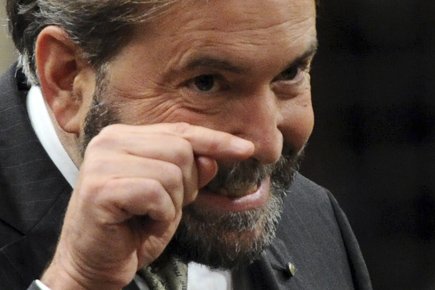 |
| Tom Mulcair Describing his Fear of Trudeaumania II |
Prime Minister Harper and his party are still doing very well in the West, especially Alberta, Saskatchewan and Manitoba. Interestingly, he is doing better in the last two than in the former. The NDP is still very strong in Quebec and strong on the question of who cares about people "like me", and the Liberals are doing well in the Maritimes and in Ontario. The NDP are also competitive in the Martimes, Ontario and The West.
The Liberals have been gaining in Quebec, but the NDP's support is not exactly evaporating contrary to doomsday prophesy in the media since the 2011 election.
Under these longer term trends (which have been the conventional wisdom for several decades) there is also the rise of the Trudeau Liberals. But, let's keep in mind that that has just happen and there is typically a honeymoon period with any new leader.
Though leadership often trumps policy, there is little reason to see Mulcair as lacking on that front either. Compared to Harper, Mulcair is charismatic. When compared to Trudeau, Mulcair is a silver tongued orator who reminds one of Mulroney.
Thomas Mulcair may have slipped in recent weeks, but there is still a long time to go and the narrative we are faced with on election day is almost certainly entirely unpredictable at this present moment.
Subscribe to:
Posts (Atom)